THOUGHTS ON TEACHING ~
My passion for teaching lies in my respect for the tradition and history of my profession, as well as my hope for its future. I regard teaching as an extension of the necessary inter–generational dialogue between artists to keep theater alive and vital. Supporting and nurturing younger theater designers is imperative. Mentorship and personalized, individual attention have become the backbone of my teaching.
My teaching philosophy is framed by my belief in service.
I view my role as an educator as an actor of service – to both the profession I have pursued, the communities in which I live and work, and to the future generation of artists I hope will change the world. Ultimately, as both teacher and collaborator, I believe my primary role is to foster an environment true to my values as an artist, and the values of our design program – an environment of cooperation, respect, and inspiration – where artistry can emerge, grow and flourish in support of a play or performance. I work to create a brave space for learning and exploration. My teaching philosophy embraces a belief in setting aside ones’ ego in service to a play, performance, or collaboration – and this underscores my approach to teaching. I do not subscribe to a top–down, hierarchical method, where my own agenda or aesthetic is the focus. And I do not believe that there is a “right” way to solve a particular staging need, create a visual solution, or embody an event. I teach that design choice or theatrical moment “works” only in the moment of its existence – in the communal experience of performance.
My hope is that through mentorship, discussion, and demonstration, my students will realize the best versions of themselves – to be inspired to become more of who they are, not less. President Obama referred to this approach as “leading from behind” — a process of setting goals, creating examples, and imagining possibilities, but ultimately allowing students to find their own design sensibility and artistic voice.
Graduate school provides a young designer an extraordinary opportunity to accelerate their accumulation of experience and knowledge. By taking the time to invest themselves wholeheartedly to their craft and practice for a definitive period of time – without having to worry about economic constraints – a young designer can experience a profound period of artistic growth.
My mentorship and pedagogy is thus focused on three areas:
1. INDIVIDUAL ARTISTIC VISION
The first area of focus is strengthening each student's point of view and developing their personal artistic expression. This effort involves getting to know each student – who they are, their background, and how they arrived at Northwestern.
It is important to understand what aspects of their experience have informed their point of view and what they want to do with it. Developing a students’ personal expression and perspective involves testing, evaluating, and pushing against their prior intuitions and impulses.
In the classroom, I teach primarily through critique and conversation. As a class, we look at their work, discuss their design choices, and explore their relationship to the source material. Without focusing on what may be wrong or right, I ask questions that require a student (and their peers) to contemplate different interpretations of their choices and to compare and contrast their choices with other possibilities and/or perspectives. We discuss what design choices seem to support or illuminate the source material – dramaturgically or artistically – and what choices may not.
This development of artistic self–awareness is a central objective in my pedagogy. It is important that each student and designer know that their point of view has value, but also, that their work exists in service of a larger goal — collaborating with a team to create a unique, seamless, and inspired performance–event.
As theater artists, we are yoked to the text, to the performer(s), and to the experience of the audience. A student designer might have a bold concept about the world of a play, but what if that vision does not support the action described in the script? What if an idea leaves the audience distant and aloof, when the goal of the performance was to achieve catharsis and connection?
Ideas are tested in the classroom through discussion and debate. Students need to hear their mentors’ and peers’ feedback, as a means of accurately judging and fine–tuning their perceptions about others’ responses to their ideas.
2. DESIGN PROCESS
A second point of emphasis in my pedagogy is the teaching of a time–tested Design Process – a way to move from “page to stage.”
For a young designer, or artist, understanding how to approach the “blank canvas” of creative work can be daunting, even scary. I teach a process that embraces failure as a necessary part of taking risks and being innovative.
The design process I teach asks students to move from world–conceiving, to world–building, to world–communicating – and gives my students a methodology to fall back on when they are uncertain of how to approach a particular moment, or problem in their creative work. It is an artistic process that amplifies and supports their personal point of view and imagination(s) and centers their role in the creation of a performance–event. The design process I teach is layered and multi–dimensional, requiring a diverse grouping of skills and efforts, incorporating a wide range of dramaturgical, contextual, and subjective–intuitive factors.
When world–conceiving, scenic designers begin by reading a text repeatedly, then researching and seeking to understand the world of the play (text/music/choreography) by gathering and organizing all the important information that will define the parameters of the performance–event – and how the scenery must support the event. I frequently reference Eleanor Fuch’s “A Visit to A Small Planet” – in asking designers to think about “rules” of a world, envisioned by the author. These “rules” are the way participating artists and an audience will come to understand how an event is meant to function, or live – and how the elements that make up a created world (actors, space, sound, time, etc.) are meant to relate to and exist with one another.
They must honor their own role as a vital part of creating the performance–event and consider what their own artistic point of view reveals about the text/music/movement/etc. In class, we embrace the ethos stated by Carl Rogers, “that which is most personal, is most universal”.
While world–building, a designer will refine and develop their idea(s) through iteration and collaboration. Continually discussing aesthetic choices with ones’ collaborators to assure that the work of all design disciplines is simpatico and cohesive. In this part of the process, a scenic designer must imagine and consider how other theatrical design disciplines – costume, lighting, and sound design, in particular – will function and look, in relationship to the scenery during a performance. Generosity of spirit, patience, and empathy are essential soft–skills to develop, and greater awareness of how an audience will understand and respond to the created–world is imperative. Considering whether ones’ work is emotionally resonant and intuiting the response of an audience to gauge the impact and effectiveness of aesthetic choices.
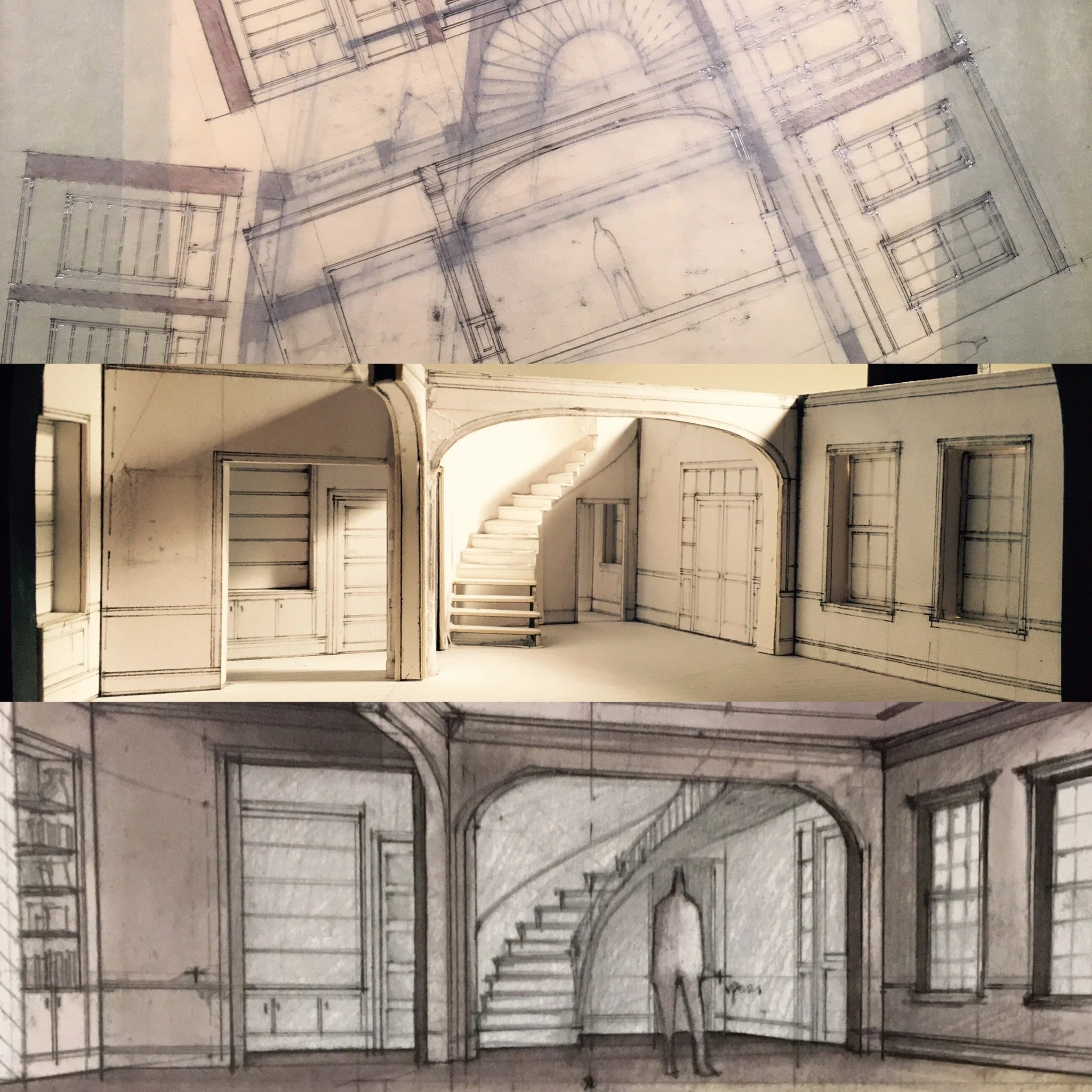
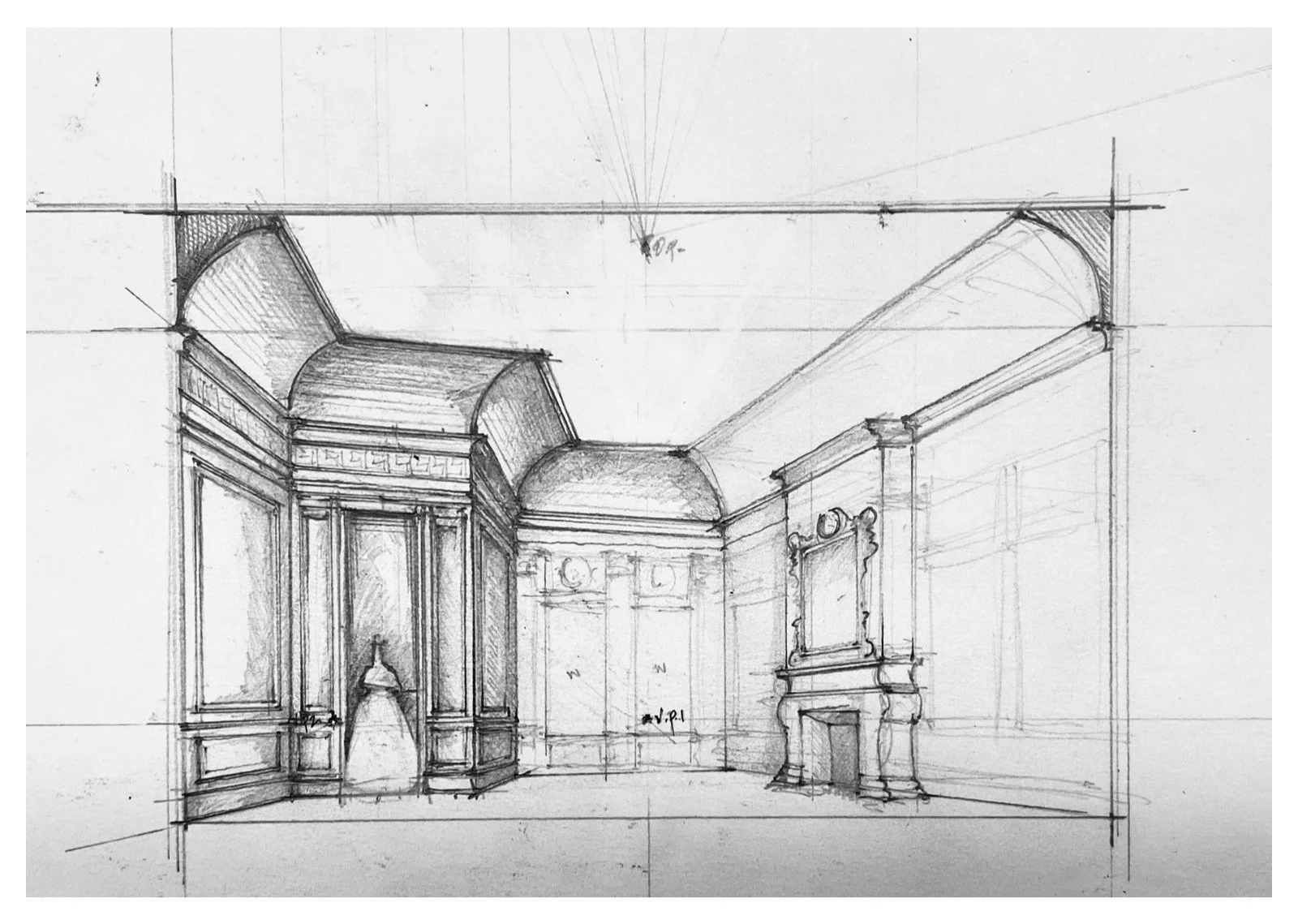
Finally, when world–communicating, scenic designers must create content (drawing and model–building, for instance) that visually communicates the form of a design – its scale, use of space, relationship to the theater, etc. In this part of the design–process studio–related skills are of paramount importance. Drafting, model building, painting and drawing, and computer skills all become essential tools for communicating ideas to the technicians and artisans that will build ones’ design – as well as the artists who will inhabit the created world. Scenic designers at Northwestern are asked to articulate a design through scaled structural drawings as well as painted or printed elevations; to examine and consider building and painting techniques with an understanding of material, color theory, and structural integrity.
In class, we often discuss how substantive and elongated this last part of the design process can be – extending all the way through the construction of the scenery, its’ installation into a performance space, the technical rehearsals where other design–disciplines are layered into the world and actors join us onstage; and into previews – when we first see how an audience will respond to our work. In many ways, the early, hyper creative world–conceiving portion of a design process can be most exciting – but it is during the world–communicating segment of the process that creative–play becomes a professional endeavor. Scenic designers spend the vast majority of their time communicating with the many intersectional parties that work to build the world they have conceived.
The design process I teach at Northwestern allows each student to practice these skills and efforts with the purpose of reflecting on, and developing their abilities – strengthening their communication and craftsmanship, while testing what techniques work best for them. The process becomes foundational for their careers.
3. ASSESSMENT OF COLLABORATION
A final area on which my mentorship focuses is monitoring and evaluating students’ collaborative skill and tenor. Relationships and communication for artists can be challenging and fraught with pit–falls.
At Northwestern, I work with students as both sounding–board and guide, providing feedback about their demeanor and professionalism within the context of their collaborations. Theater designers must work with a wide variety of people on any given project – from primary collaborators like directors and other designers, to the artisans and craftspeople that will implement a designers’ vision.
Different teams and different people require different ways of communicating, born from their alternative needs and priorities. And navigating these important relationships can be tough. As stated in each of my syllabi, my goal is to help each student build communicative, organizational, and collaborative skills fundamental to the working environment of the theater.
Outside of the classroom, my mentorship of students is manifest in a number of ways. I regularly meet with students to advise them on their realized productions and theses portfolios. I attend design meetings when I am able and invited. I counsel undergraduates on their coursework, their participation in the set design module, and their own realized designs.
I work to find enriching summer experiences for all of my graduate and undergraduate students – including regularly employing multiple assistants and an intern each summer. Finally, I invite students to attend rehearsals and previews for any local productions that I have worked on.
As a teacher and artist, I believe in continually evaluating both my intention and my impact. And thus I am always seeking to be attune to, and aware of, necessary changes to my pedagogy, my teaching methods, my demeanor and outlook. My development and improvement as a teacher will continue, in perpetuity. I regularly seek out feedback from current and former students, and colleagues about their experience with me in the classroom. I continually reflect on the evaluations I receive.
Since arriving at Northwestern, I have been regularly altering and tweaking the syllabus for each course I teach, testing the effectiveness of certain class structures, time management, and modes of feedback. I am sensitive to the needs and sensibilities of each class and student and respond as personally and generously as I am able – within the appropriate boundaries of a teacher–student relationship.
These past years, I’ve focused intently on decolonizing my curriculum, my syllabi and class structures while embracing anti–racist teaching practices. I find I am continually learning as much from my students as they are from me. And it’s been my pleasure to support former students as they enter the profession to become new collaborators and peers.